

Underground Astronauts
This edition is available to all (except the paid exclusives). Support my work and upgrade to paid here for as little as $5 a month.
LISTENING: to my little sis snore away
FEELING: excited for amsterdam!
SEEING: the sun break through my hotel room window
I'm writing to many of you from the future. I'm in Amsterdam for the next few days to meet and interview Toby Kiers, executive director of the Society for the Protection of Underground Fungal Networks, or SPUN. She won this year's Tyler Prize for Environmental Achievement. She's an underground astronaut, aka a mycologist. I'm the global media fellow selected to tell her story for a global audience. (Editors: holla at me if you're interested in a pitch!)
I've never been a big fungi nerd. I'm picky about how I cook my mushrooms. When I see them in my local park, their textures and orifices give me the skeevies. Maybe it's a slight case of trypophobia? I have written about them before. One of my most viral stories during my time at Atmos was about "The Last of Us" and the real-life lessons from fungi. I've, yet again, found a new sense of appreciation for these organisms. I mean, these dudes have been around for hundreds of millions of years. Us? We're a blip in the timeline.
 Atmos
Atmos
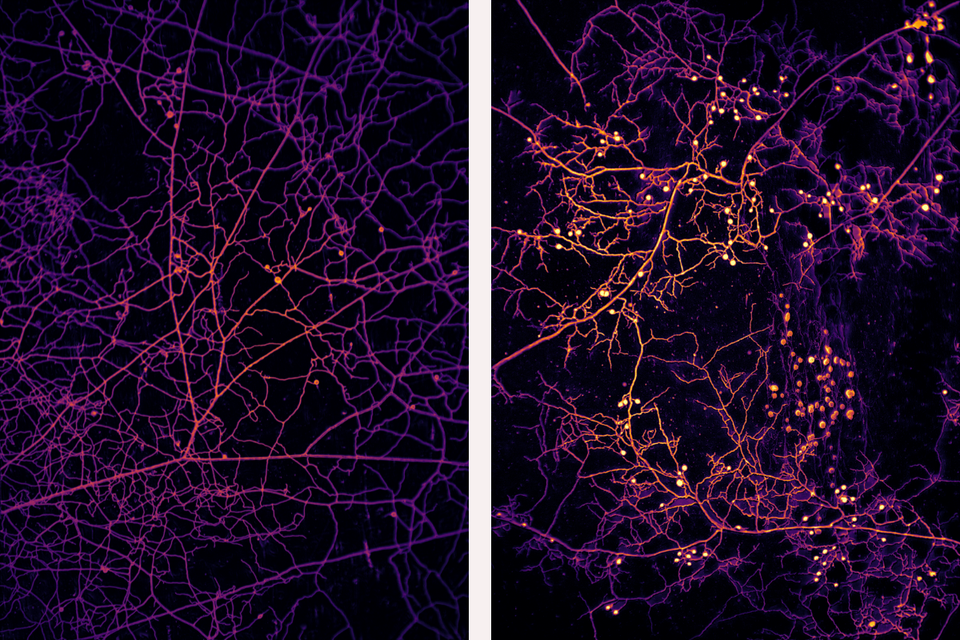
Kiers and her team at SPUN estimate that underground fungal networks store 13 billion tons of carbon a year. For reference, the U.S. emitted 5.4 billion tons of carbon dioxide in 2023. Imagine the possibilities if we maximized the potential of these fungal networks. If we studied them and took better care of them.
Kiers advocates fiercely for the defense of these organisms. That's why she's calling for Earth Day to become Underearth Day. There's biodiversity in the fungal kingdom. They deserve more attention and protection. Some crucial species are in locations already succumbing to climate collapse, such as Ghana, whose coast is already feeling the effects of sea level rise despite being what her team has deemed "a global hotspot for fungi." Indeed, their research found that 90 percent of these ecosystems were in unprotected areas.
It's worth remembering that the evolution of fungi is, in large part, why carbon is now stored underground rather than in our atmosphere. Their creative nature helped make life on Earth — life for us — possible.
How does any of this relate to climate justice and historically marginalized peoples? Well, I was excited to hear that Kiers is working directly with Indigenous groups in several communities, including in Ecuador, to map their fungal networks. Many of the fungi there are endemic; they can't be found anywhere else. The work is fighting, in part, to stop extractive mining industries from infringing on fungal ecosystems.

What are we losing when we lose those organisms? (The research is giving "Common Side Effects" from HBO. Go watch it if you haven't already! It's seriously so freaking good!)
"We really need to understand these organisms, and we need to start dreaming big about how we can work with fungi," Kiers said during an Underearth Day press briefing Monday.
I'm excited about the collaborative nature of her work — and its global focus. SPUN has developed an Underground Atlas to help everyday folks explore the mycorrhizal networks across the globe. Research like this keeps me going. There's so much to learn about our natural world. We know more about space than we do about what's beneath our feet. That's why Kiers calls her team underground astronauts. It's time for lift off. 🌀
The newsletter ends here for free subscribers. Why not upgrade?
Rest in Power
While we can't say for certain that climate change led to these specific weather events (we need attribution studies for that), we do know that the Earth's rising temperatures are already creating more frequent and/or stronger disasters like these.
Grateful to not find anything this week.
Currently Reading
Finally! Some journalism I'm proud to share I've worked on. For The Meteor, my story on the reproductive health harms of tear gas is out. For the Society of Environmental Journalists, I wrote about why journalists on this beat need to cover the silencing of protest. In Peace & Riot, I speak to South African activist and artivists Kumi Naidoo about AI.
I applied to that Daniel Singer fellowship and went down a rabbit hole reading the late writer's work. I enjoyed his 1982 essay for The Nation, "Solidarity Will Never Die."
As a fellow social media addict, I needed to read this story by Ariana Eunjung Cha for The Washington Post on how to do a detox. I'm about to download the app mentioned, Freedom. :')
Poetry
FROM A MELTING POT TO AN ICE BOX
they say the United States of America is a melting pot / but people don't melt into one anymore / they freeze over — and, sometimes, they die / bodies are thrown into la hielera, never to be seen again / or they're thrown to the gators, disappeared by domestic terrorists / remember alligator alcatraz? / I wonder what the days were like when we all joined hands together / melting and dancing in the pot / singing our songs and sharing our meals / that energy is still alive / I feel it in my dear Queens / I see it here in the streets of Amsterdam where I hear and meet other Spanish speakers
but I don't know if people back home would
melt in love if thrown in a room together
I think we'd freeze
stunned and confused
we'd freeze
cold, ugly, dead
-ylf-
- Yessenia xx

Comments ()