

Climate Fiction Needs More Romance

LISTENING: to the whole "A Walk to Remember" album
FEELING: excited to see my friends tonight
SEEING: all the gorgeous art of Grist's latest cli-fi collection
I'm a sucker for romance. Some might call me a hopeless romantic. I sob at even the lamest rom-com. When I watched "A Walk to Remember" as a teen, I made an entire MySpace custom layout dedicated to the film. "Only Hope" by Mandy Moore played on my page. Some of y'all may be judging me, but I have no shame. Stories of romance are powerful. They had a serious hold on 13-year-old, yet-to-be-kissed Yessenia.
On a more serious note, though: Love is a universal emotion. It's a desire most people understand. Everyone wants to fall in love, right?
Imagine my delight when I dove into "To Labor for the Hive," the first-place winner for this year's Imagine 2200: Climate Fiction for Future Ancestors contest from Grist. I look forward to this contest every year. This year's winner, however, opens up the short story with a little romance — and heartbreak. I was immediately sold.
Welcome to Possibilities, a creative climate newsletter on the possibilities that lie where crisis meets community. I’m Yessenia Funes, and I love climate fiction.
This year's winner, Jamie Liu, lives in New York City and works as a climate resilience planner in their day job. She also volunteers for Sunrise Movement NYC. She writes all types of fiction: short stories, novels, screenplays, and interactive fiction. They're from the San Gabriel Valley, a region with a large Asian-American population in Los Angeles. You can see those hints of home in the story.
They wrote a dope story that touches on many different facts. It opens with love, but it carries through other themes, as well. For my climate nerds, you'll find timely issues such as the extinction crisis, community science, a just transition, heat waves, and even artificial intelligence featured throughout.
Stories — especially fiction — play a critical role in shaping public perception of issues. Given the urgency of the climate crisis, we need more books and novels and short stories that explore the emergency without beating us over the head with science and numbers.
We need characters. We need heartache. We need happy endings.
I asked Liu about their winning story. The interview is below. It's been lightly edited and condensed for clarity. Keep reading for an excerpt of her short story. Definitely check out the whole thing. I couldn't put it down.
This one's for paid subscribers only. Maybe it's time for an upgrade?
Q&A With Jamie Liu: 'We Can Save Ourselves'
What inspired you to write this story?
I came across a news article about a woman in Bangladesh who sent tide gauge data to the government department responsible for distributing early warning messages. I loved the idea of using participatory science to drive climate resilience, and I started incorporating other climate elements I want to see more of in stories: a focus on extreme heat (which is often an invisible hazard despite having the highest human health impact), nature-based solutions, and resilience hubs.
I also wanted to include themes of labor and purpose and community. When we tie our self-worth to transactional jobs and relationships, it's very easy to feel lacking. I don't blame people for being wary of work when it's associated with a capitalist system that often drains us so we can survive. But we need to do work to address climate change and other inequities. What if, instead, we labored for each other and for the planet? What if we nurtured communities where we didn't have to fear abandonment? What if we lived in a world that made room for all that?
Why the romance? It was my favorite part of the piece and so refreshing to see a climate story that wasn't just about climate but about people and relationships. Talk to me about why you felt compelled to write about this.
My favorite thing to write is fun character dynamics. I love rom-coms, and I knew I wanted to have a cozy rom-com vibe. But I also think that if we want to fight climate change, we have to bond better as a community, which starts with our individual relationships. I love writing relationships like the one between Huaxin and Anshui. There are flickers of romance that offer a bit of tension, but there's also an intensity that goes beyond romance and contrasts in their personalities, allowing both characters room to grow. The relationship also helps Huaxin encounter additional fulfilling relationships by letting her discover her found family.
These relationships aren't built on charity but on solidarity and mutual aid. Technical climate solutions are important, but building a better future also counts on us extending more care to others and even ourselves. When we can no longer count on people with institutional power to fulfill our demands, we must carry them out ourselves, and we'll need each other to do that.
Why are climate fiction stories like these so important?
Climate fiction dares us to imagine the future we want to build. Having a vision in mind of where we're headed is important as we do the day-to-day, year-to-year work so that we don't lose sight of our values and have the energy to carry out our goals. It's not that I think the future should look exactly like what I've portrayed in my story. But we've been taught for so long the way things should be that trying to imagine something different feels radical.
We've moved a long way in the climate change narrative. We shouldn't be focusing anymore on proving that climate change is real and that humans are causing it and that the future would suck if we did nothing about it. That's already been said. We should show what's possible when we actually try and propel people to action.
Why should these stories feature and center cultures that the mainstream often ignores?
I think there's often a misconception that environmentalism and caring about climate change is a thing for wealthy, white people. But that's not true. Mainstream narratives fail to capture how marginalized populations care deeply about climate change, often face the worst impacts from it, and may have the most innovative and equitable climate solutions. Stories that center the cultures of marginalized populations bring all that into focus.
Young people in marginalized communities, especially, need to see themselves as climate leaders. We don't need to be saved; we have our own unique ties to nature through our lands and cultures that can help us seek climate solutions. We can save ourselves and share stories that show how it can be done.
How do these types of stories help us achieve climate justice?
If climate fiction will help us address the climate crisis, then it must also call for climate justice. We have to listen to what frontline communities are saying about how to reduce emissions and build resilience without harming the people who already suffer the most. Storytelling is a great way to convey this. If people read and write these kinds of stories, we can use them to better shape our demands and actions to fight for climate justice.
Anything else?
If there's one takeaway I want people to have from my story, it's to find your community. Look for people who are trying to improve the world around them and join them. It can help you feel less lonely and helpless. Climate change — and many other stressors — can feel very paralyzing. If you join a group, you help build a community to face the paralyzing thing. And the next time a crisis hits, you are no longer just one person; you have the power of many. It will take work to build that community, but the labor we give to each other is the most precious kind of all.
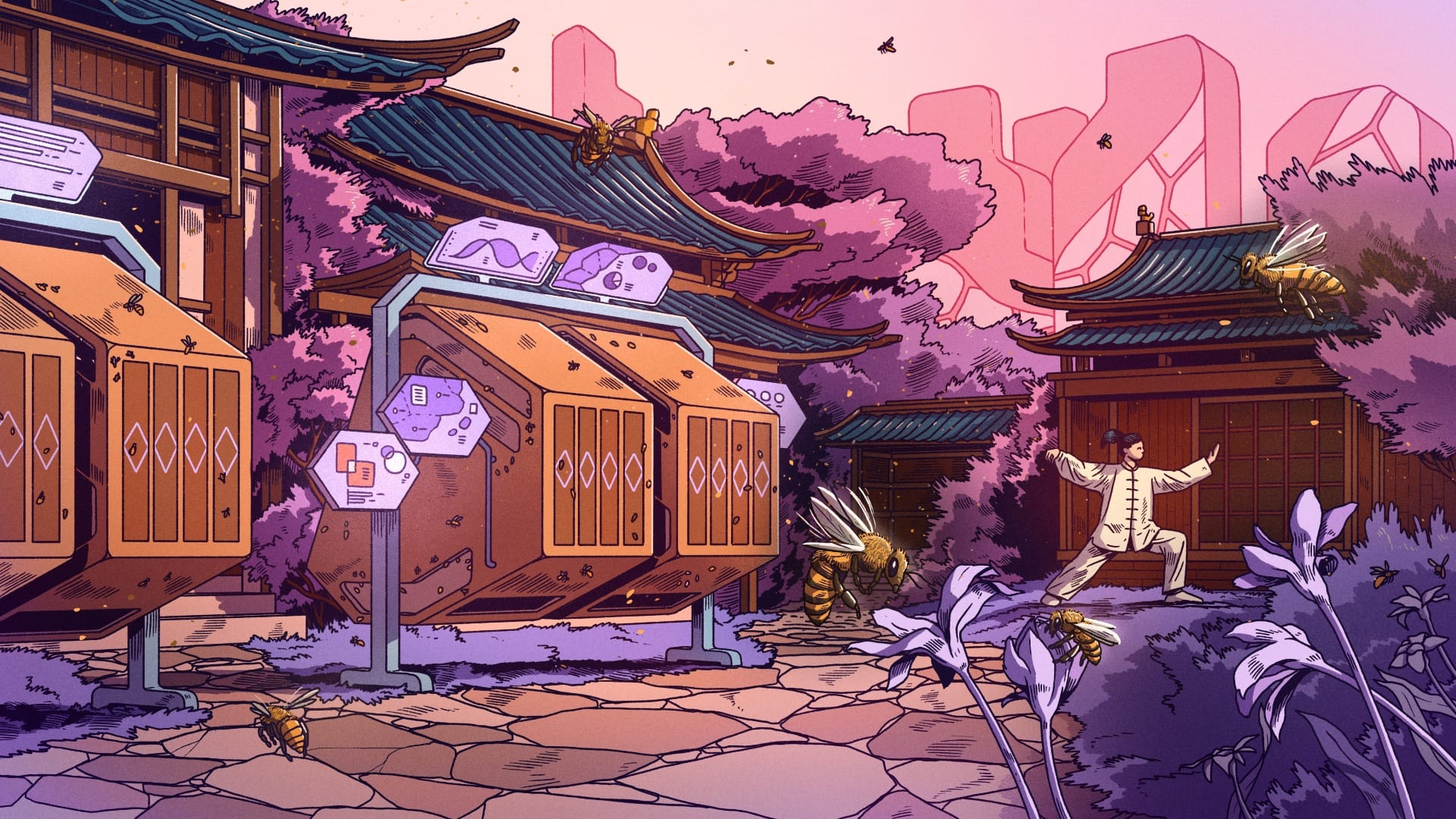
Illustration by Stefan Große Halbuer for Grist
The rest of the day was like any other, with the addition of her data duties. She tended to her garden. She visited the porch when people rang to buy her products. She made lunch: yellow squash from her garden, stir-fried with fermented black beans and tofu from the weekly market. She texted updates to Anshui, who didn’t respond until the end of the day with a “thank you.”
Someone knocked on the door. The sun had set by now, so Huaxin already knew who it was. “Hi, Ms. Chen. The usual?”
Ms. Chen gave a curt nod. “And two lychee honey sticks, please. Need something to drown out the medicine tonight.”
Huaxin nodded, fetching the jars and sticks. Ms. Chen was her elderly neighbor — well, if one counted a neighbor as someone who lived two hills away. She’d lived a nocturnal life ever since she lost her job decades ago when countrywide protests caused the country to shut down its last coal mines. Their little town had celebrated. Ms. Chen had not. With no family, she’d taken pride in her work and found her purpose lost after that work disappeared. She’d lived in isolation ever since, except to visit town every once in a while to grab groceries, or buy honey from Huaxin.
Huaxin felt a kinship with her.
“Hot today,” Ms. Chen said as she took the honey. Their few exchanges of conversation had to do with the weather. As it was with people who never talked to others.
“Yeah.”
“I hope it was worth it.”
“Sorry?”
Ms. Chen gazed into the distance. “Shutting down the mines. I hope it helped. The heat would be worse, right?”
Oh. She was talking about climate change. Huaxin always avoided the topic with Ms. Chen. It was the global effort to decarbonize that had lost her her job, after all. And yes, shutting down the coal mines was a good thing. But the government had not made sure she’d had another livelihood to jump to after the transition.
Still, it wasn’t bitterness in Ms. Chen’s voice. Instead there was … guilt? Regret?
No. Ms. Chen’s eyes were watery. She’d been forgotten. Abandoned. She wanted to know her abandonment was worth it. It wasn’t the income she would have missed the most; the country’s social programs meant no one needed to work to survive. But Huaxin knew that for Ms. Chen, her job had also provided her a sense of routine, of camaraderie. Ms. Chen mourned the loss of that.
“Yes,” Huaxin said. “It would be worse.”
Read the full story here.
Rest in Power
While we can't say for certain that climate change led to these specific weather events (we need attribution studies for that), we do know that the Earth's rising temperatures are already creating more disasters like these.
As of Monday, the death toll from the winter storm that tore through the South hit 34 in Tennessee. Across the U.S., the death toll is estimated to be more than 90.
A landslide that hit China's Yunnan province Monday has killed at least 31 people. Locals are speculating that a nearby coal mine may have been behind the landslide.
Currently Reading
My latest story for Atmos dives into what's happening in El Salvador, my ancestral lands. There, environmental activists are up against a growing authoritarianship.
My quarterly column for the Society of Environmental Journalists highlights key environmental and climate justice stories for 2024. Take notes, y'all!
Looks like the Biden administration is wisening up and shutting down plans for a proposed liquid natural gas terminal in Louisiana that would be the country's largest.
After people got pissed, the COP29 committee added 12 women. Better late than never, I guess?
Housing is a human right. Now, we have evidence of how fracking threatens that.
Russia is still waging a violent war in Ukraine. It's affecting climate science.
Poetry
we hold onto our dreams
for the starless nights
when you look up
and darkness grimaces back
we chase away the nightmares
that wake us with fright
dreams can melt
and night terrors can rise
but it's up to you
to flash a light
living nightmares unfold
all around us
not all have the luxury
of a morning respite
-ylf-
See you next week. xx
- Yessenia

Comments ()